As a researcher and writer at the Ontario Jewish Archives, Blankenstein Family Heritage Centre I helped with the acquisition of a donation of materials regarding Canadian Jewish communists Dick Steele and Bill Walsh. Here is the the blog post I wrote for the OJA’s website and a video I created displaying some of the materials in the collection:
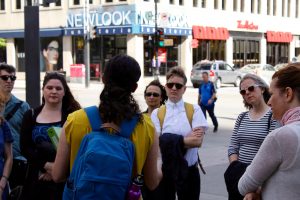
On September 18, 2016 I led the Thinking Through the Museum group on a walking tour I helped develop with the Museum of Jewish Montreal called Work Upon Arrival based on oral histories collected in the 1970s by Seemah Berson in her book I Have a Story to Tell You. The tour was later reinterpreted as the Museum’s first pop up exhibit Parkley Clothes: 1937. I guided participants on the physical version of this tour developed for Jane’s Walks. En route, participants tested a variety of interpretive tools used in the digital and physical version of the tour. In addition, given the historical and contemporary presence of Indigenous people on the terrain traversed by the tour, participants were invited to discuss, among other questions: how can the story of early 20th c. Jewish immigrants productively intersect with Indigenous stories past and present? Check out the photo gallery.
Decolonizing Curatorial Pedagogies, the title of the Thinking Through the Museum (TTTM) team’s 2nd workshop held in Ottawa on April 15-16, 2016, was a mouthful to utter and a brain-full to unpack. The three-day workshop brought us to the Canadian Museum of History, Âjagemô gallery at the Canada Council for the Arts and an indigenous walking tour of Ottawa. In her keynote lecture, Dr. Amy Lonetree challenged us to think about how museums can become decolonizing sites by centering indigenous worldviews (such the inclusion of the “Blood Memory” gallery at the Ziibiwing Center of Anishanabe Culture and Lifeways) and incorporating the difficult history of colonialism into contemporary exhibition practice. Roundtable discussions at Carleton University invited faculty, students, curators, and community to grapple with decolonizing theory and practice in and beyond classrooms, museums and galleries. From the enthusiastic participation of everyone involved, it was evident that the workshop was a successful endeavor in conversation with the Truth and Reconciliation Commission of Canada’s final report.
We call upon the federal government to provide funding to the Canadian Museums Association to undertake, in collaboration with Aboriginal people, a national review of museum polices and best practices to determine the level of compliance with the United Nations Declaration on the Rights of Indigenous Peoples and to make recommendations. (Article 67, Truth and Reconciliation Commission of Canada Final Report and Calls to Action, 8).
Decolonization is not a Metaphor
Throughout the workshop I wondered at the use of the term “decolonizing”. While the workshop focused on the settler-colonial context of Canada, Drs. Erica Lehrer, Ming Tiampo and Monica Patterson reminded us that decolonizing is one subset of a critical museology that should also build solidarity between activist curators engaging with historical trauma in multiple locations. Decolonization historically involves violent forms of resistance and the formation of independent nation states that themselves create new systems of oppression and thus should be seriously contemplated and clarified when applied to pedagogy in educational institutions.
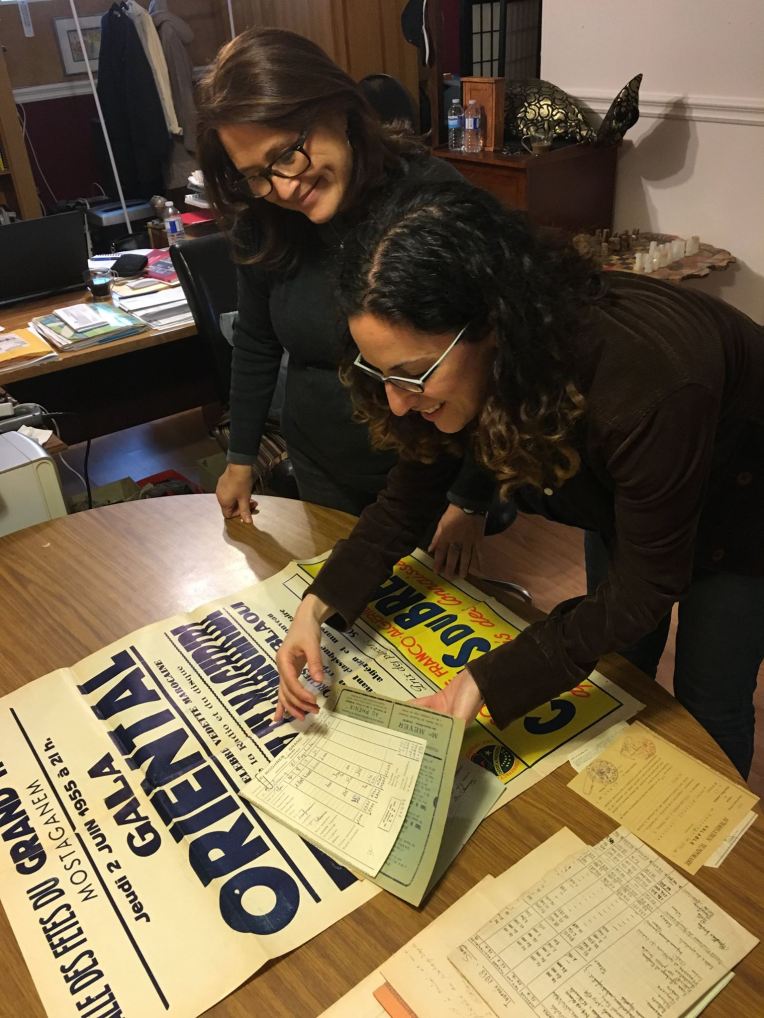
Amazing couple of days working with Yolande Amzallag, Chris Silver and Jessica Roda building an inventory of the archives of Samy Elmaghribi. I helped develop a system to document the materials and mark items that are priorities for conservation. In the archives are master recordings of various formats, rare books, sheet music, documents related to Samyphone Records and Samy Elmaghribi’s tours in the 1950s, hand written correspondences and other treasures. What a treat to be working with such a passionate and talented team!
“The chair of SGWU’s Fine Arts Department, Alfred Pinsky, was not satisfied with that visual trick and insisted on a more substantial base for the optically heavy top. He introduced the fieldstone for the sidewalls of the foyer, an unusual look in high-rise buildings.”
I just finished reading Parallels and Paradoxes: Explorations in Music and Society, a series of conversations between Edward Said and Daniel Barenboim. Among the many fascinating topics discussed in the book is the conflict Barenboim experienced in regards to playing Wagner’s operas in Israel after the Holocaust. In 1936, when Toscanini conducted the Palestine Philharmonic Orchestra (founded that year by Bronislaw Huberman) Act 1 and Act 3 of Wagner’s Lohengrin were on the program (despite his well known antisemitism).
This discussion of the esoteric world of opera and the Jewish connections prompted me to pick up a book that had been sitting in my library for months (which I had scavenged from a heap at the side of the road) on the Canadian Jewish prima donna Pauline Donalda.
Her biography – born to poor Russian and Polish Jewish immigrant parents, a great uncle who was a cantor at the Spanish and Portuguese Synagogue, discovered by Mrs. De Sola, a student at Royal Victoria College, a marriage to a non-Jew that troubled her family, advocacy for Jewish refugees during the Holocaust, a stunning musical career, founding of the Opera Guild of Montreal….. etc. is fascinating.
And there were many connections with Said and Barenboim’s conversation, including this: In 1937 Donalda took a ship back from Paris to Montreal. Also on this ship was Bronislaw Huberman (himself a famous Polish violinist). He was on his way to North America to raise funds for the Palestine Philharmonic orchestra, composed of Jewish musician who had been driven out or unwilling to work in Europe because of escalating antisemitism. Upon returning to Montreal Donalda organized a concert at Her Majesty’s Theatre that raised $3000 for the orchestra.
This documentary about the 1968 Political Science Students Association occupation of the 4th floor of Stephen Leacock Building at McGill University features an incredible cast of Jewish subjects and crew, though their Jewishness is never named in the film.
It first attracted my attention because two Moroccan Jews were on the film crew. Jacques Bensimon provided additional directing and Pierre Lasry was one of the editors.
It also features among others : Harry Edel (student activist), Janice Stein (PhD student in Political Science at the time), John Shingler (former president of the National Union of South African students and Political Science Professor at the time).




 Stephanie Tara Schwartz, PhD